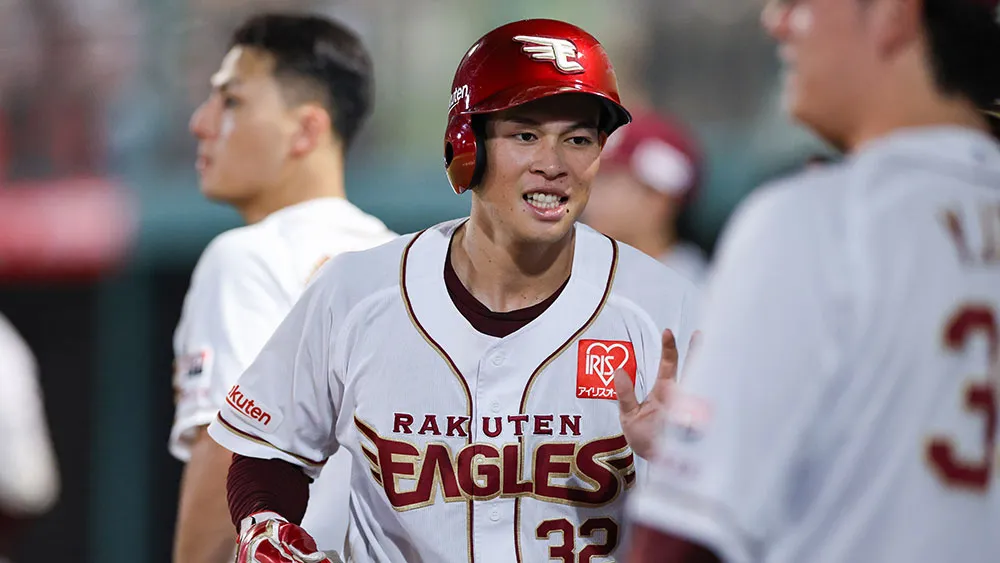
![Tohoku Rakuten Golden Eagles player Daisuke Nakashima [Photo: Provided by the team]](https://media.insight.pacificleague.com/webp/COacWZTw7JjYeSMKSGKe7uz6QtJnbYQ9gToigAr3.webp)
A third-year outfielder steadily improving his performance
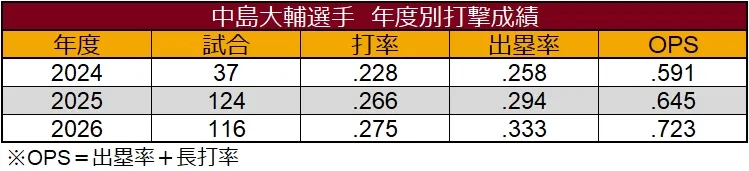
Tohoku Rakuten Golden Eagles' 3rd-year college-graduate outfielder Daisuke Nakashima. Last season, he was entrusted with the leadoff hitter role from the middle of the season and reached the regulation plate appearances for the first time. This season, his form did not improve in the early stages and he experienced a demotion to the farm team, but after being promoted again on June 25, he showed great performance with a .304 batting average and returned to the leadoff spot. Looking at his yearly statistics, figures such as batting average and on-base percentage are steadily increasing, and it can be said that he is smoothly climbing the stairs to becoming a core player.
We previously featured Nakashima in a column published on January 5 this year, where we cited "performance against left-handed pitchers" as a point of growth last season and "improvement of on-base ability" as a future challenge. Based on that content, I would like to introduce the further growth of this player, who is about to complete his third professional season. If you are interested, please take a look at it along with the previous column.
I used to be bad at facing southpaws, but now they are my specialty.

First, I will introduce the 'performance against left-handed pitchers.' Looking at the batting average against left-handed pitchers shown in the table by year, he successfully overcame the breaking balls he struggled with during his rookie year in 2024 by the following year, 2025. He significantly improved his total batting average from .143 to .288. This season, without neglecting his response to breaking balls, he succeeded in improving his batting average against fastballs. His total batting average has exceeded .300, and his matchups against lefties, which used to be a weakness, have now reached a level that can be called a strength.
Hit the ball in all directions across the field depending on the type of pitch.
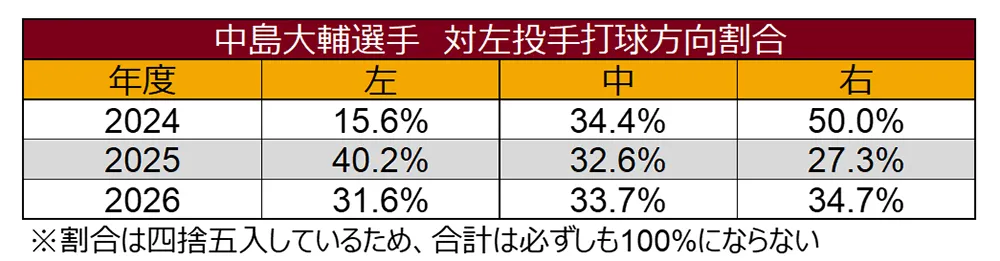
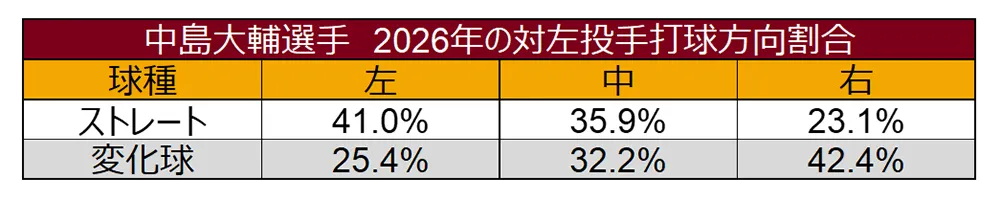
The fact that he has become able to handle both fastballs and breaking balls well against southpaws can be seen from the transition in his hitting direction. In 2024, half of his batted balls were to the right, showing a strong tendency to pull the ball, but the following year, he improved his batting average against breaking balls by focusing on hitting to the opposite field. As for this season, the total distribution across the three directions has become equal, and looking at it by pitch type, he is hitting fastballs to the opposite field and breaking balls to the pull side. It is evident that he is hitting to all fields according to the pitch speed, and this good balance is likely the reason he is maintaining a high batting average against both fastballs and breaking balls.
Improvement in the ability to judge the strike zone, which had been a challenge.

Next, regarding the 'improvement of on-base ability' mentioned as a future challenge in a previous column, growth has been shown in this area this season as well. Looking at the swing rate by zone, while the chase rate (swing rate for balls outside the zone) has not yet reached the league average of 33.2%, it has decreased by 5.6 percentage points compared to last season. Conversely, the strike zone swing rate has increased by 4.8 percentage points, indicating that his discernment of the zone has become more accurate, allowing him to swing firmly at the balls he should hit while laying off pitches outside the zone.
What is required of a leadoff hitter
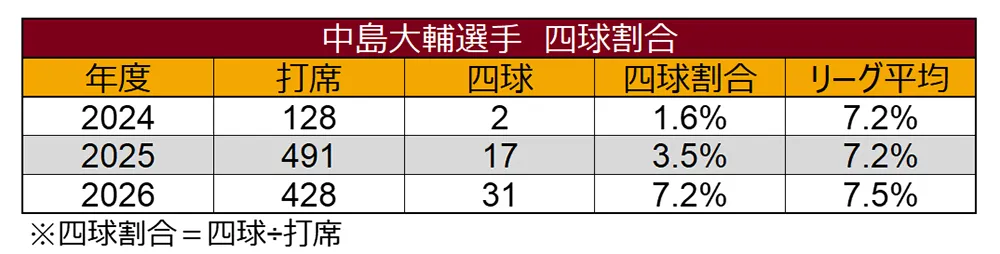
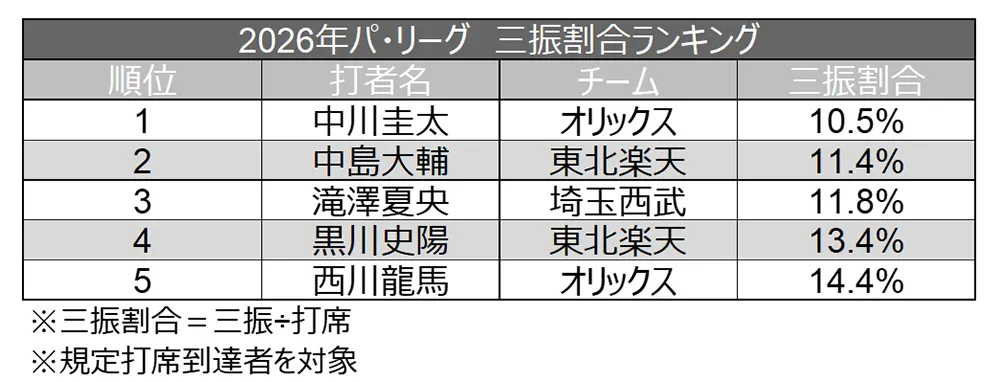
By improving his zone judgment, his Walk, which were not very frequent before, have increased. Despite having about 60 fewer plate appearances than last season at this point, he has recorded 14 more walk, and his Walk rate has improved to a level comparable to the league average. In addition, his already low number of struck out has decreased even further. His struck out rate of 11.4% is a league-leading figure, ranking second among those who have reached the required number of plate appearances. Nakajima showed his desire to establish himself as the leadoff hitter during last offseason's contract negotiations. This season, the skills required of a leadoff hitter have greatly improved, and it can be said that he is drawing a growth curve that matches his own goals.
Unfortunately, Tohoku Rakuten Eagles' finish in the bottom half of the standings for the fifth consecutive year has been confirmed. The growth of young players is essential to breaking the current situation, and the performance shown by Nakajima this season was content that inflates expectations for next season. When he evolves further, an immovable leadoff man who leads The Eagles to a win should be born.
*All figures in the text and tables are as of the end of September 25, 2026.
Text/Data Stadium
![[Participating in the Asia Professional baseball Exchange Series in Taoyuan, Taiwan] Today's Pacific League [October 12th]](https://media.insight.pacificleague.com/webp/sm5qcJrLGBicjGUHI8dp7guDrAaYOUOdHs23ZORu.webp)
![[Fan Appreciation Festival 2026] Today's Pacific League [October 8th]](https://media.insight.pacificleague.com/webp/YfXXX790qmvNiTOrXIWBSmWl7r2L6XEpui6Pneke.webp)
![[Ryosuke Tatsumi and Daisuke Nakashima Undergo Surgery] Today's Pacific League [October 9]](https://media.insight.pacificleague.com/webp/Gru89ZUqkwDOjj6QT7cRBtRyN1H58fePuOJoZsFV.webp)
![A whole serving of Daisuke Nakashima's favorite pudding! A visually stunning Pudding à la Mode Crepe [Pacific League Gourmet Club #188]](https://media.insight.pacificleague.com/webp/lPinIxgBv8NdRVxrE2FWKv9WfcJt5w3JZBEm8LX1.webp)
![Beef Pepper Rice, highly praised by Rakuten Eagles' Daisuke Nakashima as "extremely delicious" [Pacific League Gourmet Club #186]](https://media.insight.pacificleague.com/webp/DtZZRxjp3BvoQvhCE2SpOyKUOz7vgoTM5gY15mmY.webp)